
Hannibal, Mo (Zouree)
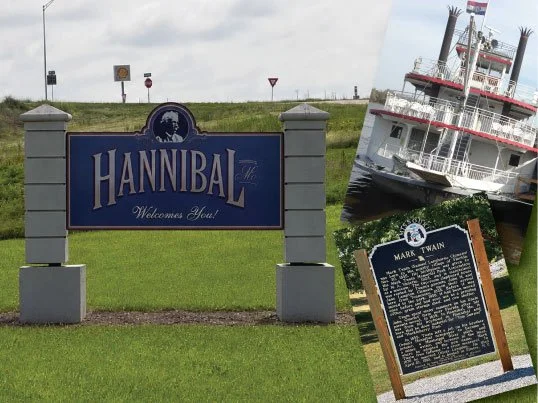
Welcome to Hannibal, Missouri.
Mention Hannibal, Missouri, to most people, and the first thing that comes to mind is probably the author Mark Twain. On a recent Saturday morning, that was not what was on my mind. My husband and I were on our way to Hannibal for something quite different—to pick up some supplies for our RV at the closest Walmart.
When we first bought our RV site at Mark Twain Lake a few years back, I was immediately excited to have a reason to get back to my roots in northeast Missouri. Having lived near St. Louis for more than 35 years, I missed the rural landscapes I had grown up with. Once my parents passed and we sold the farm where I grew up, we seldom traveled to that part of the state. But now I regularly reveled in watching the mature green soybean and corn fields pass by the windows of our blue Kia electric SUV as we drove north. Seeing a farmer maneuvering a combine or tractor immediately took me back to my childhood. Once, we even saw a drone crop-dusting, which was both fascinating and a little scary.
Hannibal is about a half hour away from our campsite, but it’s the nearest “city”—a term I use somewhat loosely for a town of about 17,000 people. Situated on the banks of the Mississippi River, Hannibal has become synonymous with 19th-century river lore, largely because of Mark Twain’s The Adventures of Tom Sawyer and Adventures of Huckleberry Finn. Twain was actually born in the tiny village of Florida, Missouri, very close to our place at the lake. A couple of autumns ago, while enjoying a weekend at the RV, we visited the Mark Twain Birthplace State Historic Site, which includes the two-room cabin where he was born.
As we approached the city limits on this summer morning, I found myself noticing billboards and signs for the town’s many attractions. Tourism is crucial to Hannibal’s economy, with places like the Mark Twain Boyhood Home & Museum, the Mark Twain Cave Complex, and the Tom & Huck Statue. Beyond Twain’s legacy, Hannibal is known for its late 19th-century Victorian architecture and as the birthplace of famous Titanic survivor “Unsinkable” Molly Brown.
It was not lost on me that Walmart is located adjacent to the Huck Finn Shopping Center, a place I remember well from my childhood. An annual trip to JCPenney in that shopping center was a must for our family as a new school year approached. Our small hometown had very limited shopping and dining options, so a trip to Hannibal almost always meant stopping at “Penney’s,” or when I became a teen, Maurice’s. Although my father was a bit of a grizzled farmer, he loved to watch my mom and me try on new outfits and give us his feedback during these outings. I can still see him sitting on one of the benches in the misses’ department, my mom’s purse on his lap and shopping bags at his feet.
These trips always included lunch or dinner out, something we seldom indulged in closer to home. Although restaurants came and went, two that come to mind from that era are Lum’s and Ponderosa. My dad lived for the salad bar at Ponderosa, and we never left hungry. Even less expensive restaurants like Kentucky Fried Chicken and Cassano’s Pizza were in our regular dining rotation when visiting Hannibal.
As Rich and I were about to turn left into the shopping center, the Hannibal Pirates sign in front of the high school across the street caught my eye. As a devoted band kid in the ’70s, I spent one day a year with my high school marching band participating in the Hannibal Marching Festival. We were one of the smaller bands, but that didn’t diminish our enthusiasm as we marched in the parade competition and later performed our polished halftime show on the Pirates’ football field. Being across the street from the shopping center also allowed us to do some record shopping during the brief amount of downtime our director allowed us each year. I distinctly remember returning one year from the record store with a 45 of Earth, Wind & Fire’s “After the Love Has Gone,” my favorite song at the time. Dodging the four lanes of traffic between the shopping center and the high school was well worth the risk.
As we approached Walmart, it dawned on me that the Hannibal I experienced growing up was much different from the Hannibal most people outside the area recognize. I don’t remember ever reading The Adventures of Tom Sawyer, although perhaps I did at some point. My only specific memory of reading Twain’s work is from junior high school, when we were assigned his short story “The Celebrated Jumping Frog of Calaveras County.”
But the biggest impact of Twain’s work on this little farm girl was the movie musical adaptation of Tom Sawyer, released in 1973. Starring Johnny Whitaker (from TV’s Family Affair) as Tom, a very young Jodie Foster as Becky Thatcher, and Celeste Holm as Aunt Polly, the movie and its memorable music and lyrics provided all I needed to know about Twain’s tales of life on the Mississippi. The release of the movie was such a big event in northeast Missouri that my family splurged on a night at our local State Theatre to see it. I don’t recall how many people the theater held, but it was packed that night. I can still remember melodies from songs like “Hannibal, Mo (Zouree)” and “Freebootin’.” Only as an adult did I discover that John Williams, one of my musical idols, conducted and adapted the music for the film. The song score by Richard and Robert Sherman and Williams’ adaptation score were even nominated for an Academy Award.
Nostalgia faded as we entered the Walmart parking lot and I remembered why we came to Hannibal in the first place. It was time to find a shopping cart and track down the trash bags, batteries, and breakfast cereal that had brought us there.